

One incident record from first assessment through to after-action review.
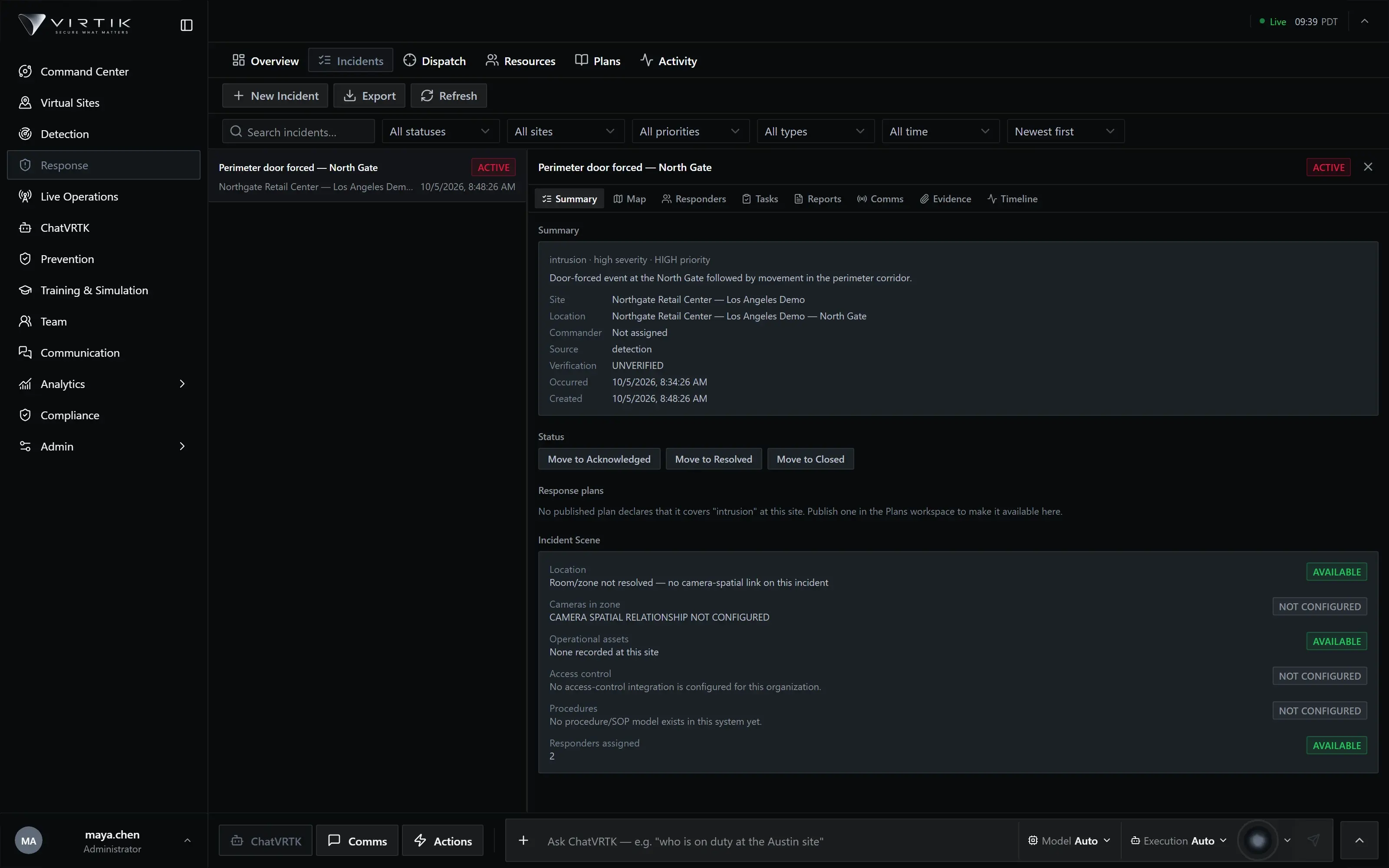
Incident assessment, resource assignment and dispatch against the same spatial source of truth.
The problem
What goes wrong without it
Detection and response usually run in separate systems, so the incident is re-keyed at the moment it matters most — and the record that gets reviewed afterwards is a reconstruction rather than what happened.
Response works from the incident Detection created. Assessment, assignment and dispatch all write to that same record, and replay reconstructs the timeline from what was actually recorded.
Capabilities
What Response does
Described from the current product build. Availability can depend on your deployment and plan.
- Assessment and resource assignment on one shared incident record
- Nearest-responder routing computed against the real site graph
- Mutual-aid coordination across organisational boundaries
- Replay and after-action review from the recorded timeline
- Responder view for the person actually attending
- Status history retained as auditable events
Operational workflow
How it is used
These are ordered stages of real use, not a feature list rearranged.
- 01Assess
The incident opens with its location, evidence and coverage.
- 02Assign
Resources are matched against availability and real routing distance.
- 03Dispatch
Responders receive the incident on the surface they are using.
- 04Review
The timeline replays for after-action review.
Operating it
Integration, security and deployment
Integrations
- Mobile devices for field response
- Notification transport for dispatch
- Mutual-aid partner organisations
- Signed webhooks for integration events (incident events are not delivered yet)
Security & permissions
Assignment and dispatch are privileged actions gated by operational role. Mutual aid crosses an organisational boundary, so it is explicitly authorised per engagement rather than inherited — a partner sees the incident shared with them and nothing else.
Security modelDeployment
- Requires personnel records with roles and availability
- Routing quality depends on the site graph being current
- Mutual aid requires a partner agreement to be configured
Documentation
Where the detail lives
Documentation for this module is being prepared against the product. It is not published yet.
We publish documentation only once it has been checked against the product, rather than listing procedures nobody has run. The documentation home shows what is written, in review or planned.
Documentation homeRelated
Modules that share this model
These read from the same sites, personnel and incidents.
See Response against your own sites
A working session using your operational context rather than a scripted tour. If your operation fits a plan available online, we will say so rather than route you through a sales process.