

Secure what matters
AI Security Operating System for Physical Sites.
Built for multi-site operations: command, detection, response and field teams working from one shared model of the site.
Try Virtik
Step through the running application.
Real screens from the current Virtik application, captured on a fictional demo organization. Pick a module, then read what each part of the screen is showing.
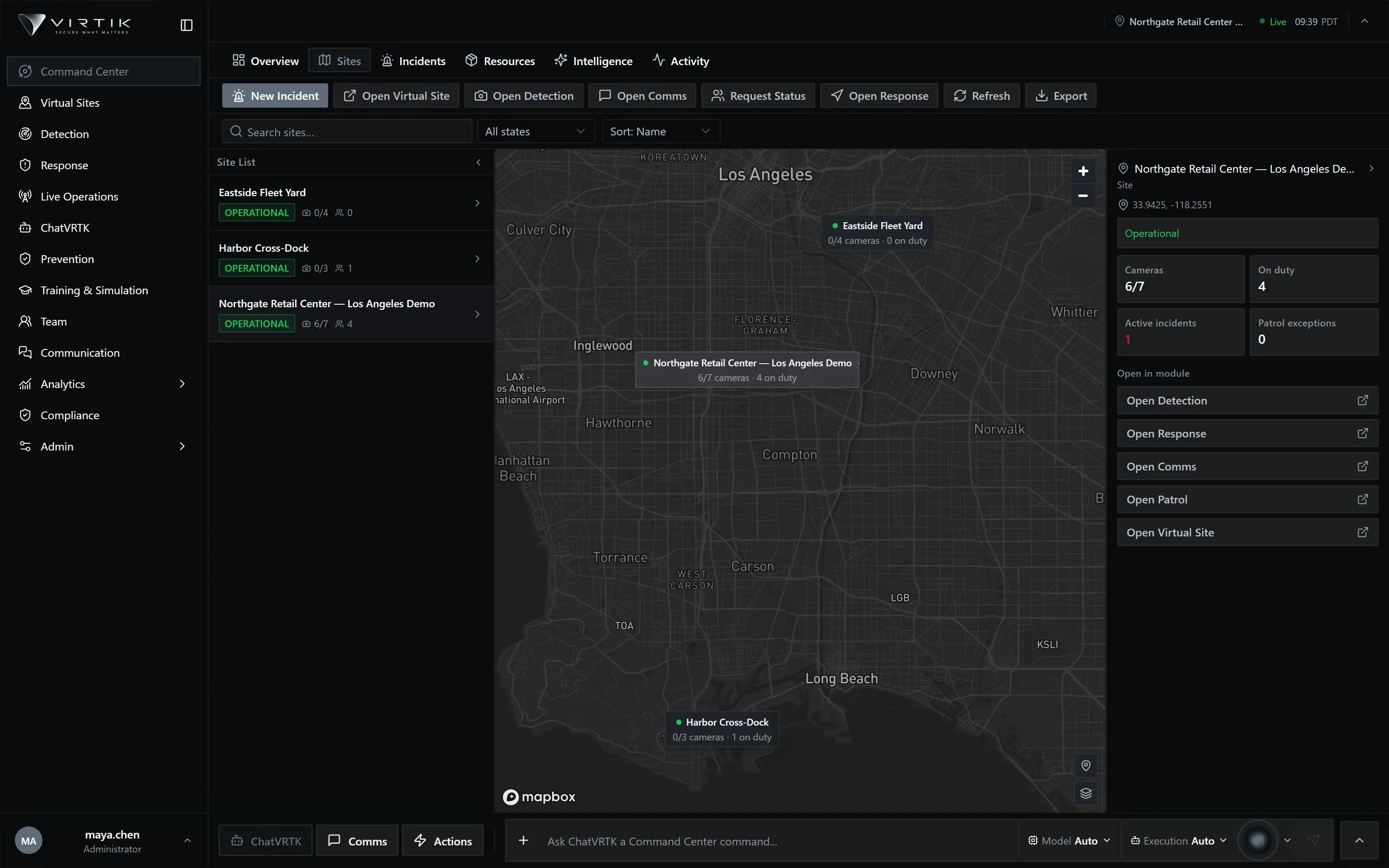
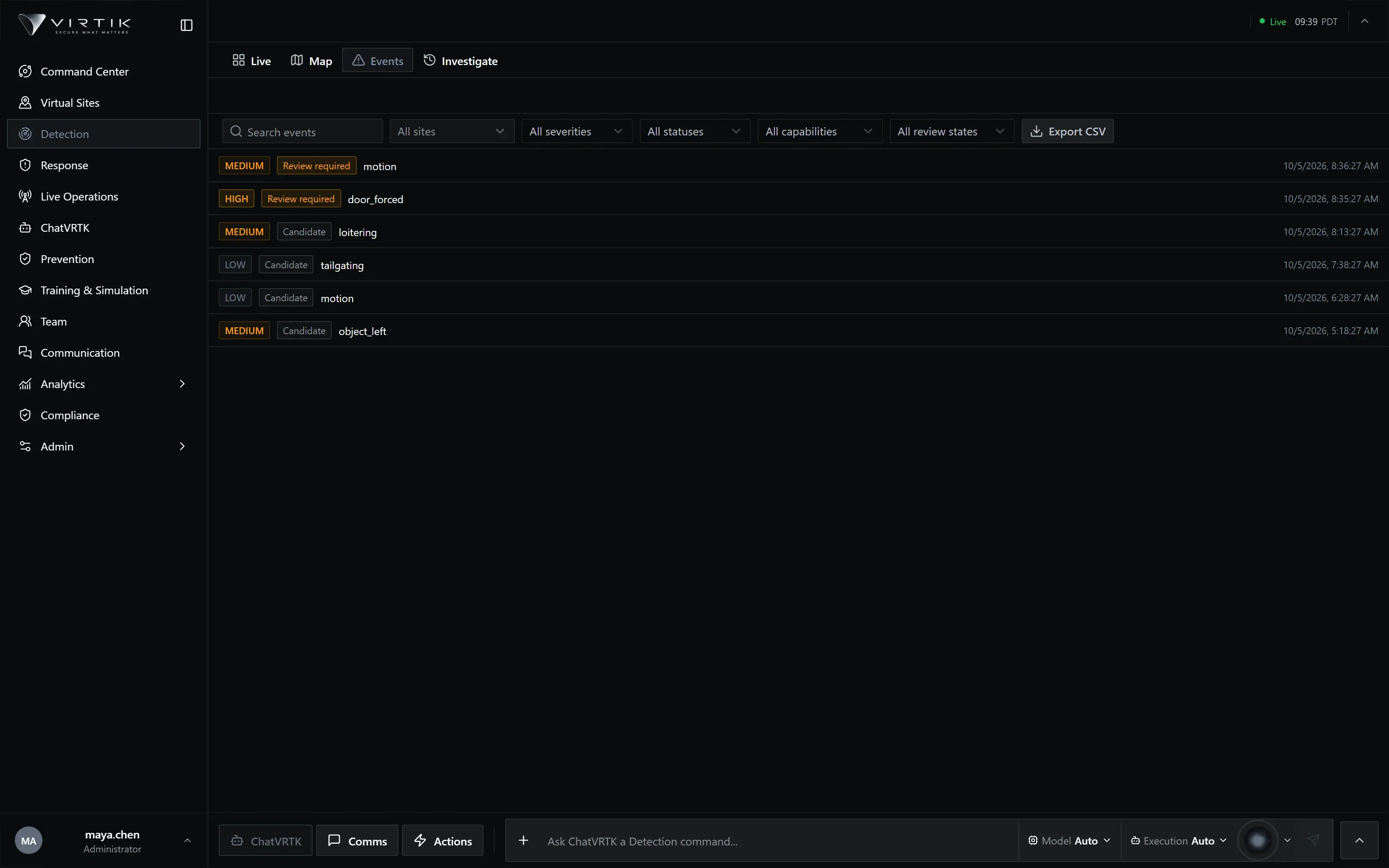
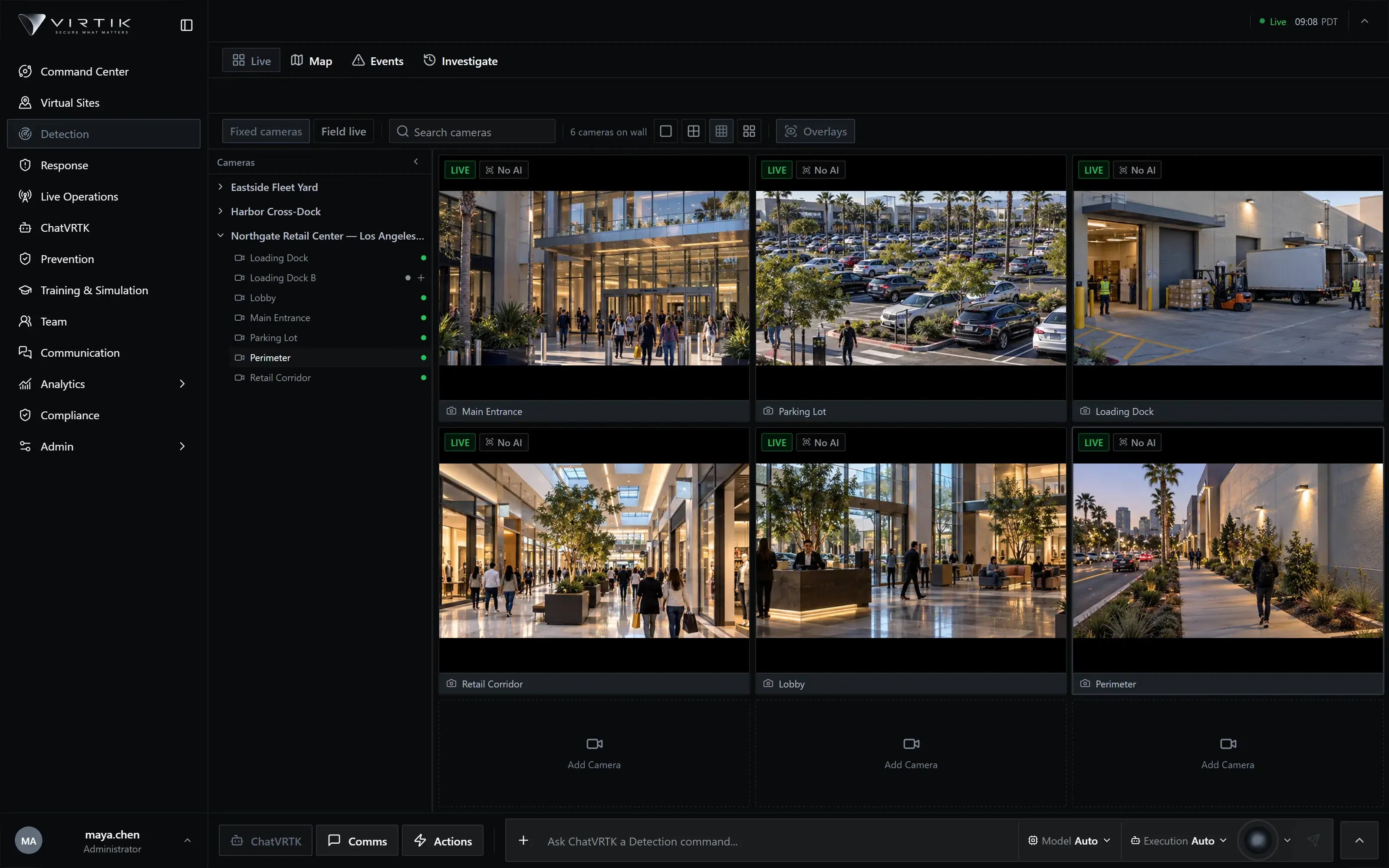
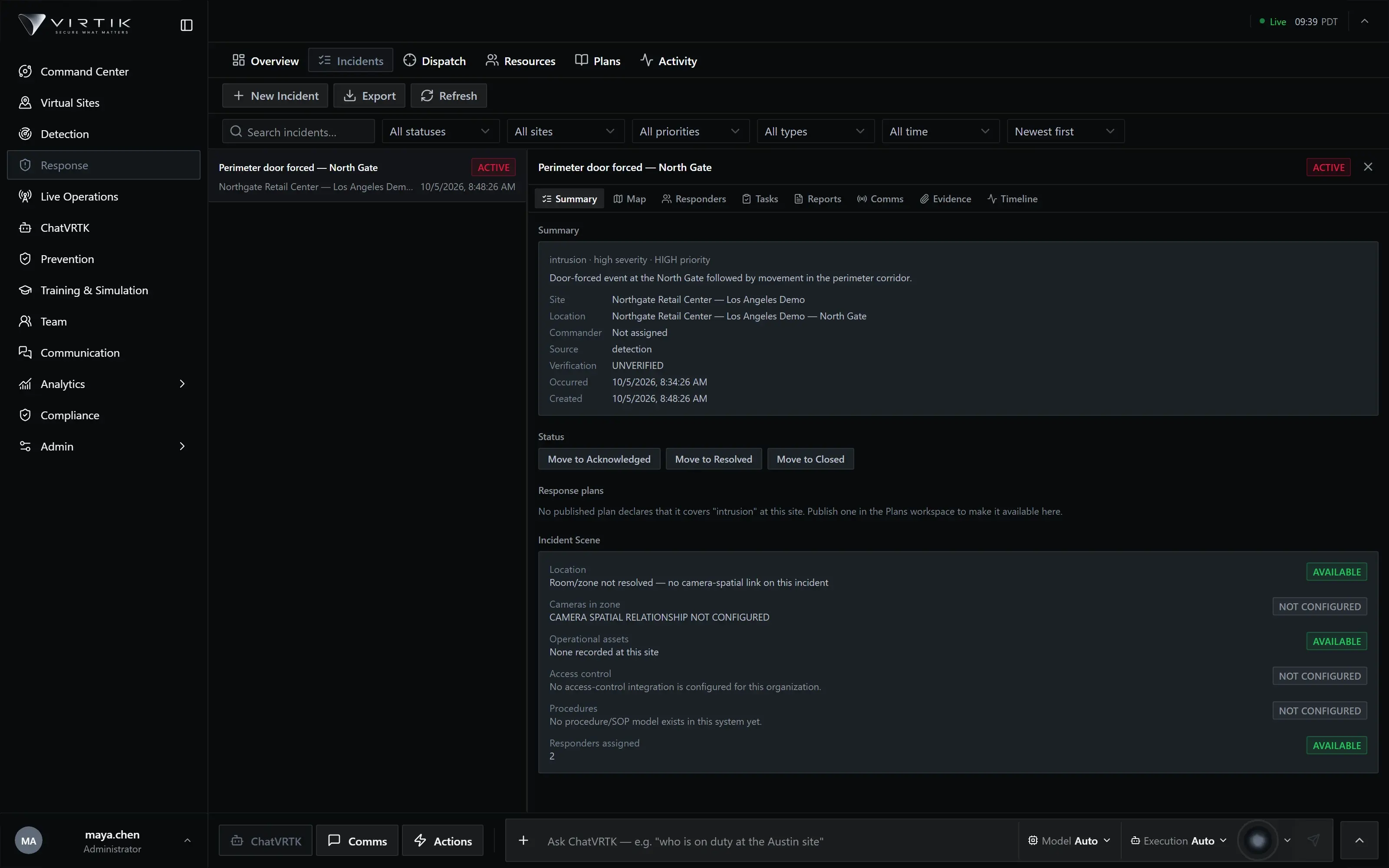
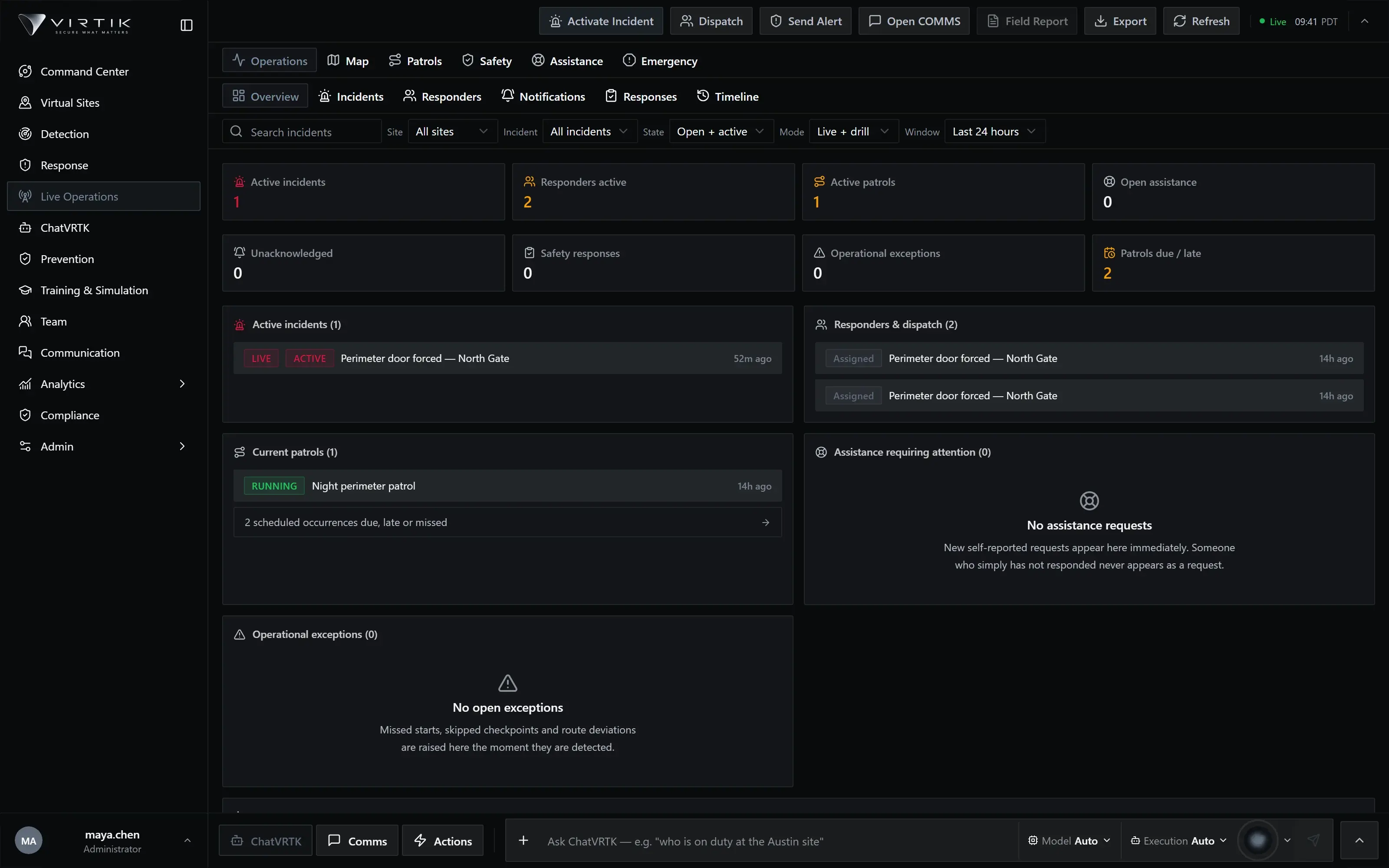
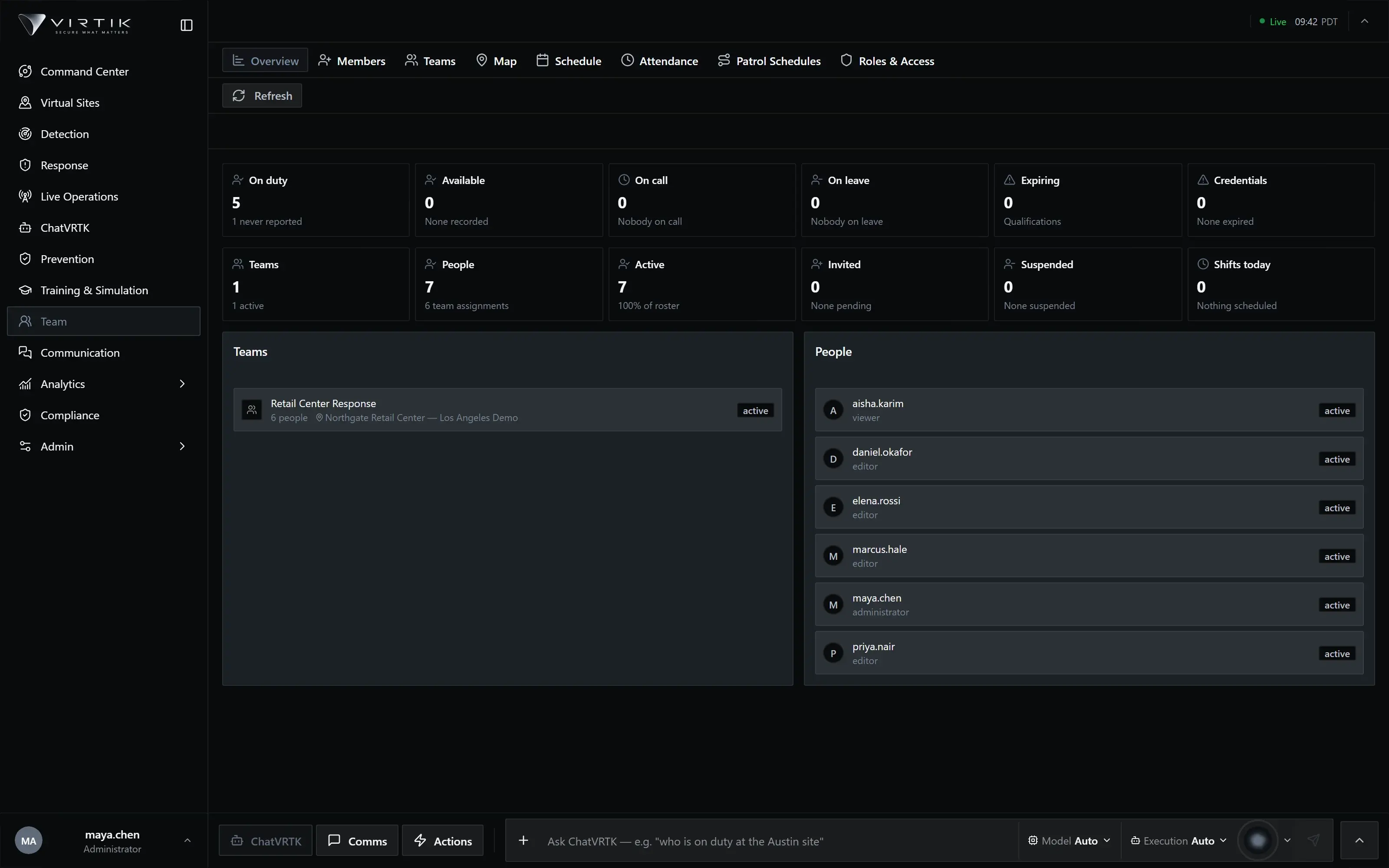
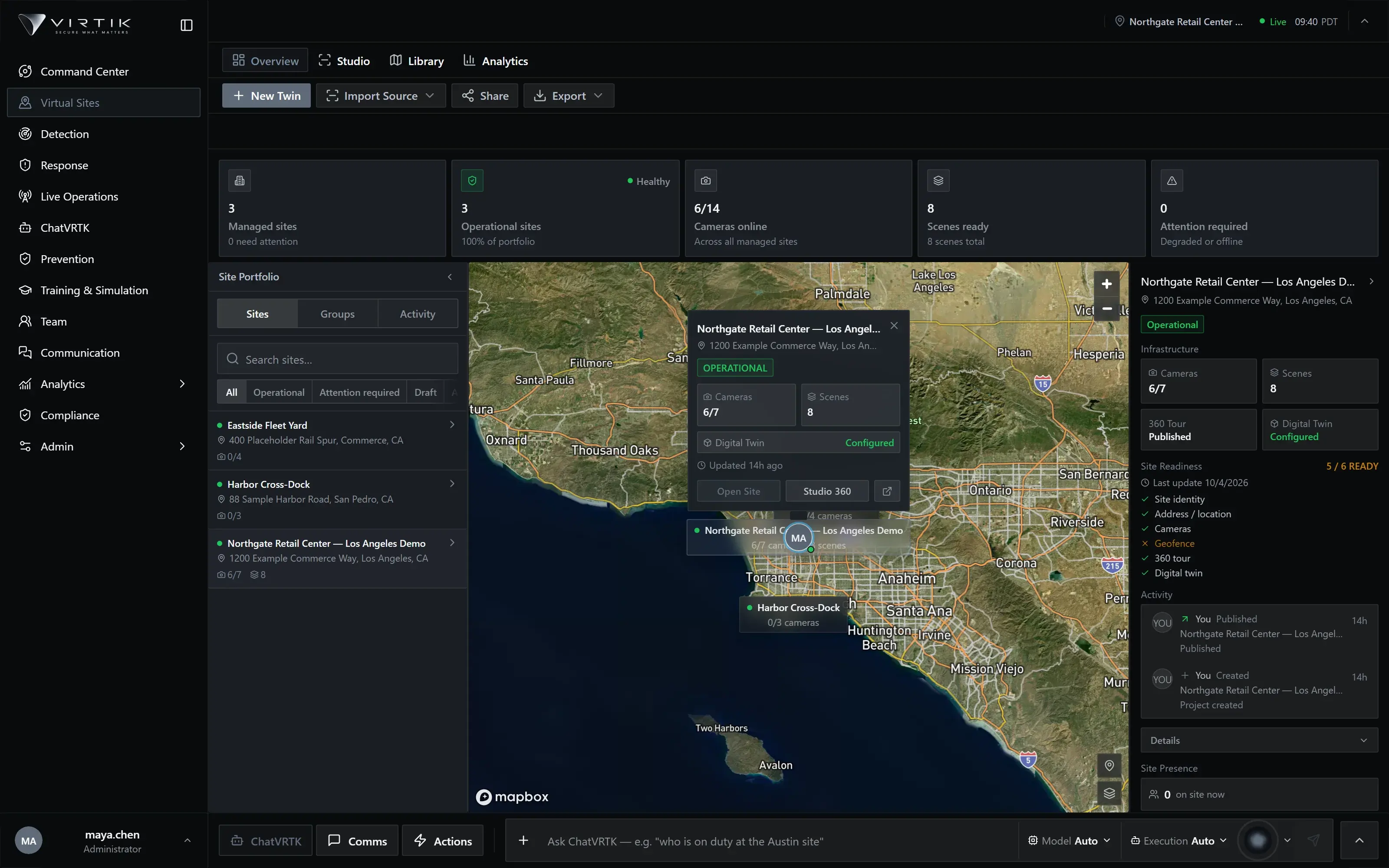
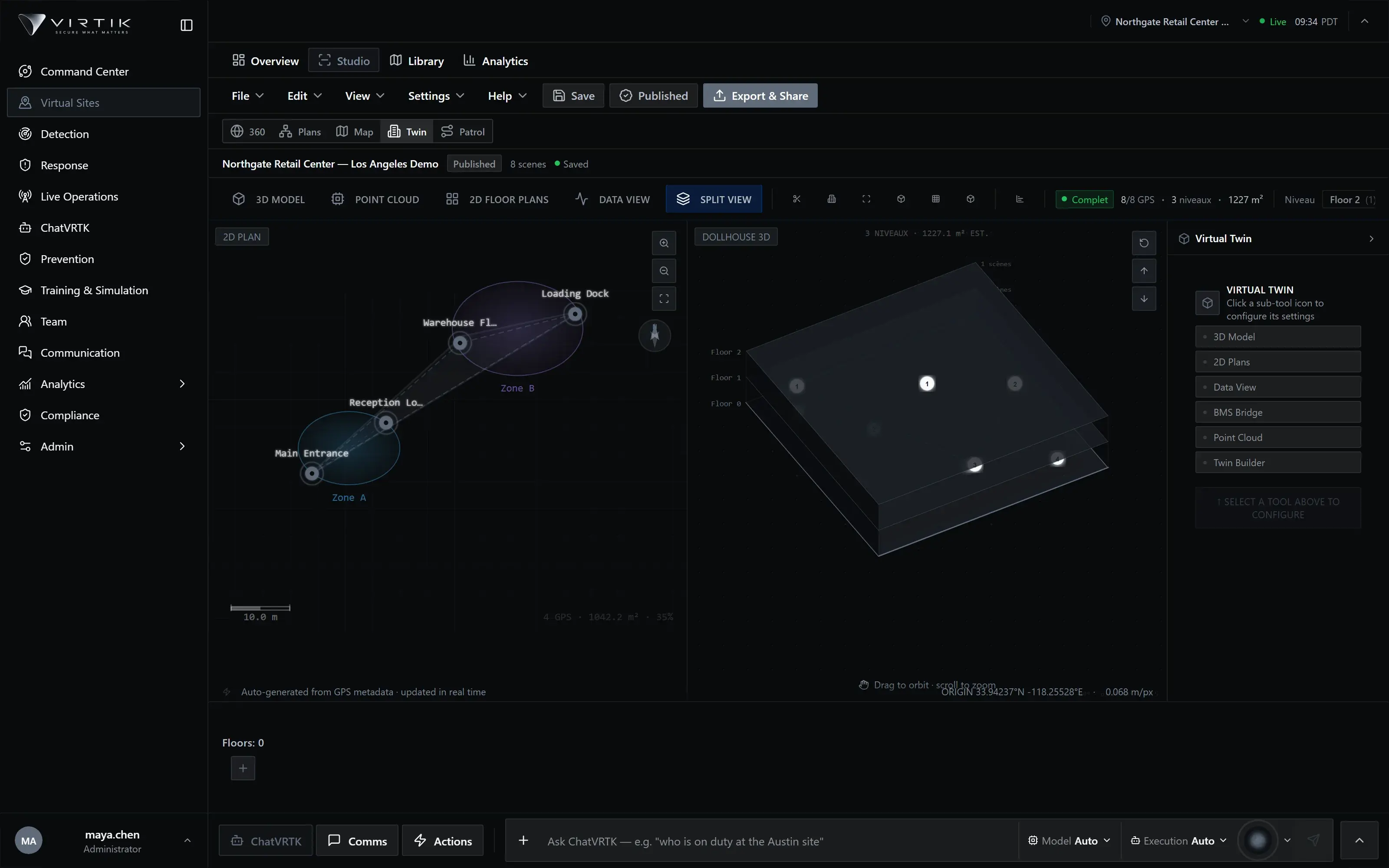
Every site on one map, with its operational state, cameras online and people on duty — and a panel for the site you select.
Demo scenario: Northgate Retail Center — Los Angeles Demo, a fictional property, followed from a forced-door alert to response. Captured from the running application. The organization, people, data and camera video are fictional demo material. These are screenshots — nothing here is a live system, a customer or a real camera feed, and the controls on the captured screens are not active.

The problem
Security operations fragment exactly when they matter most.
Most teams do not lack tools. They lack one place where those tools agree about where something is happening.
Systems that do not share a map
Video sits in one product, dispatch in another, site drawings in a third. Operators reconcile them by hand, under time pressure, during the incident.
Alerts without place
A detection that cannot say which door, which floor, which zone forces a second investigation before anyone can respond to the first.
Comms detached from context
Reaching the right responder means knowing who is nearest and already assigned — information that usually lives outside the channel being used to reach them.
The platform
Each module is useful alone. Together they are one picture.
What changes when they share a model is not the feature list — it is that nothing has to be re-keyed between the system that detects and the system that responds.
Command Center
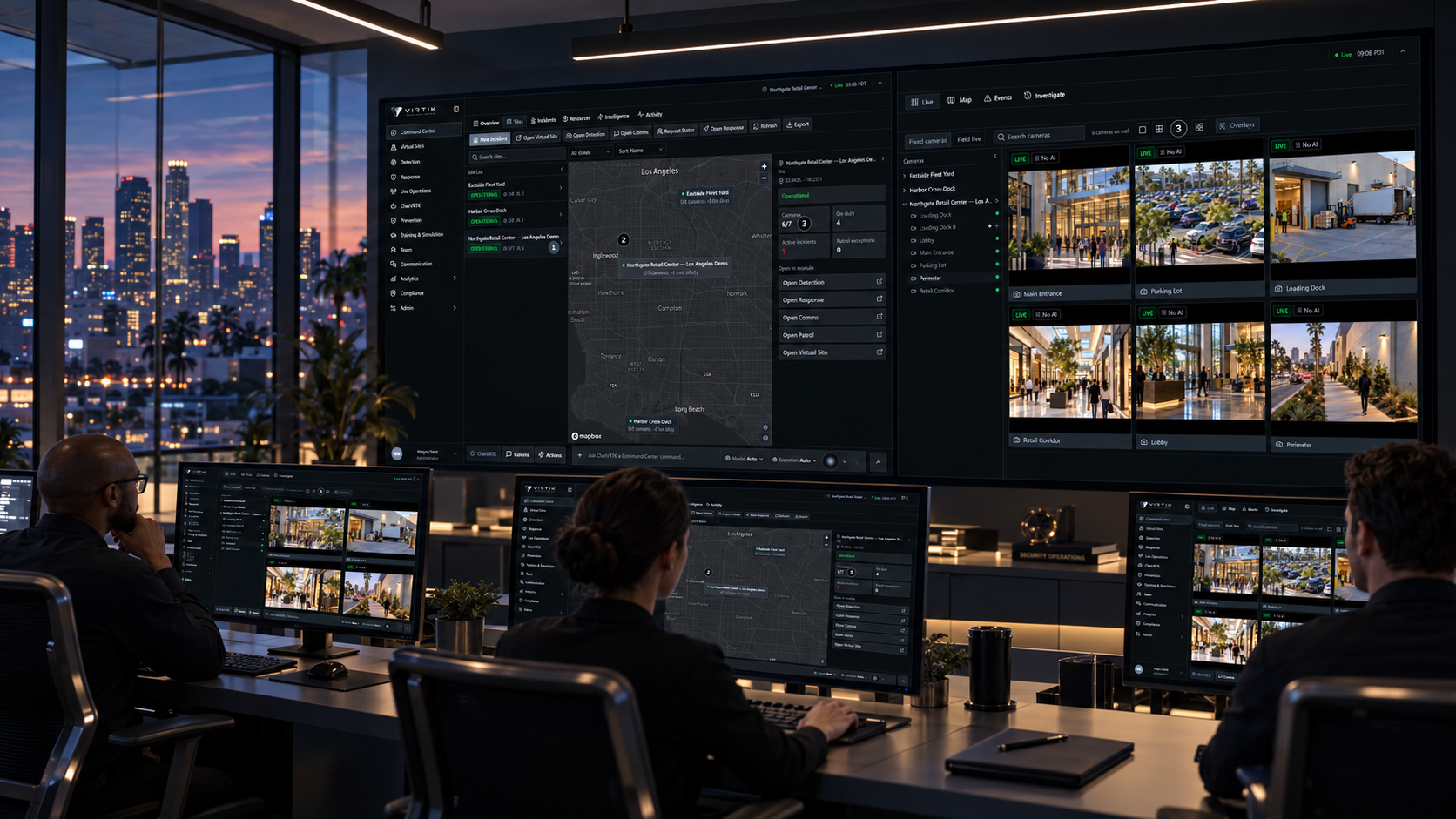
The map is the operating surface. Selecting a responder, opening an incident and dispatching are the same interaction, in the same place.
Explore Command CenterVirtual Sites
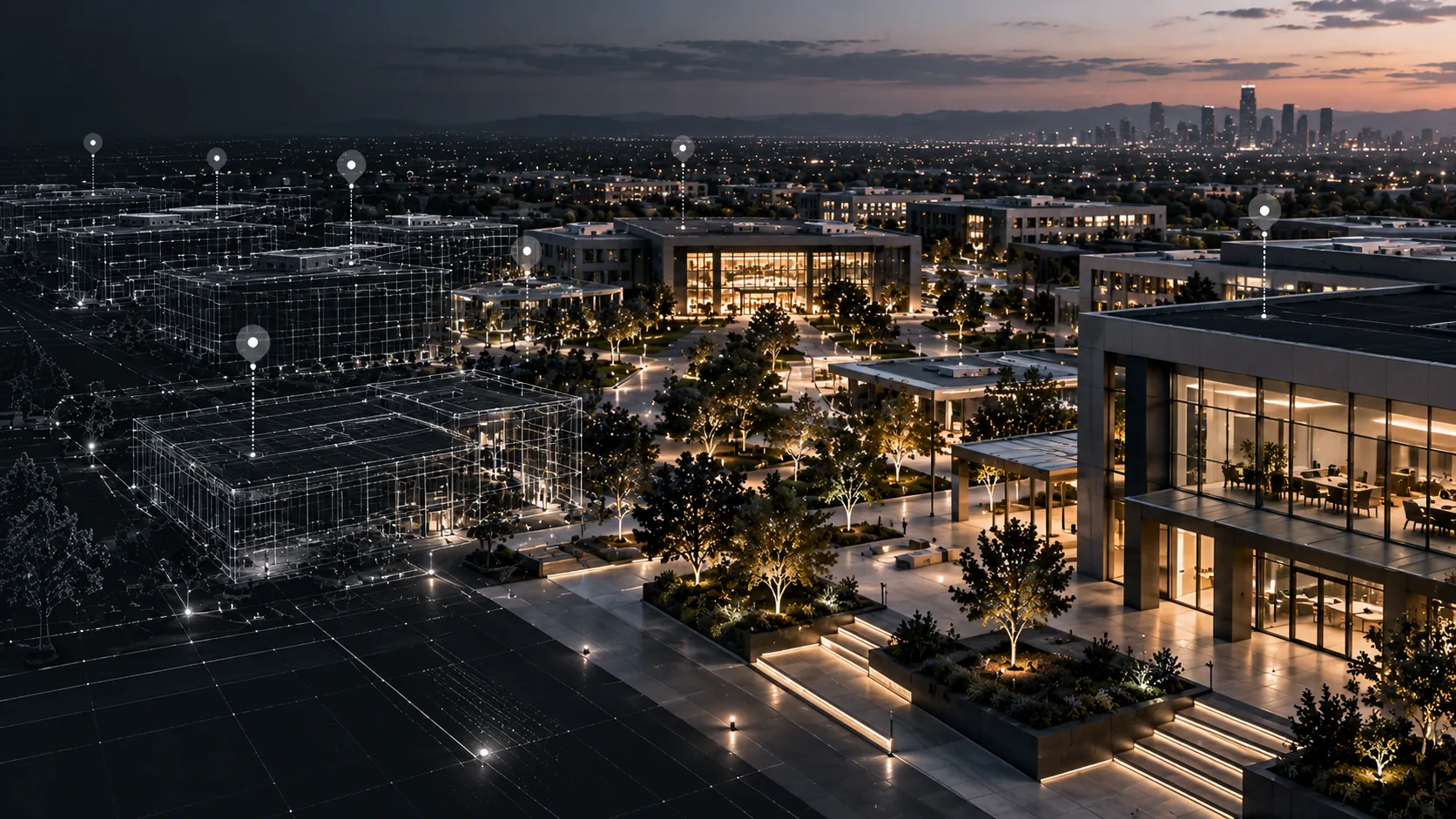
360° scenes linked into a walkable site graph, with cameras bound to the positions they really cover.
Explore Virtual SitesDetection
Events are reviewed and promoted to incidents rather than pushed to an operator as noise.
Explore DetectionResponse
Responders are routed against the real site graph, not straight-line distance.
Explore ResponseChatVRTK
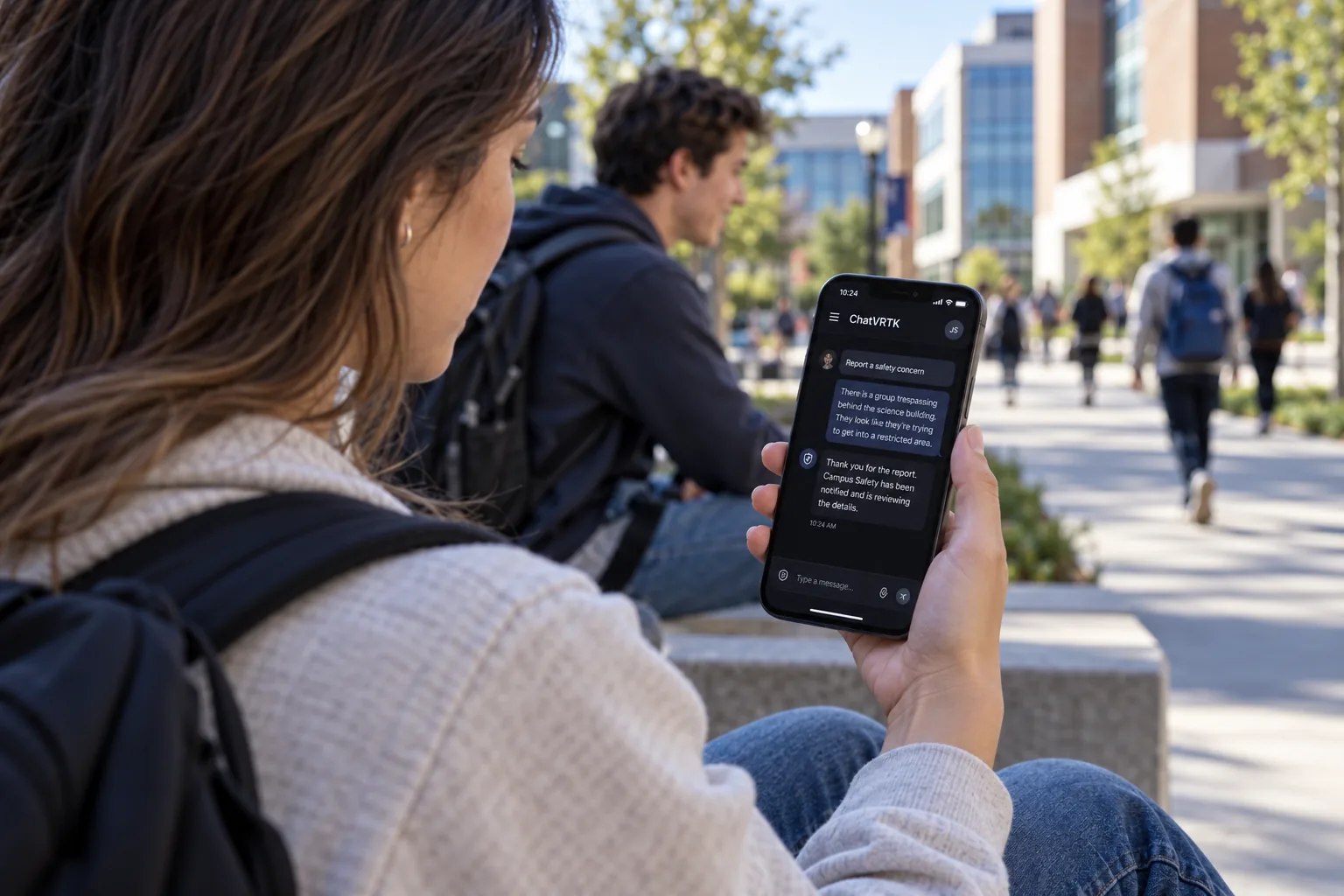
Explicit operating modes, grounded in live operational context rather than general knowledge.
Explore ChatVRTKCommunication
Addressed from the same selection the operator made on the map, with acknowledgement tracked per recipient.
Explore CommunicationLive Operations
Current state of every site, streamed rather than polled.
Explore Live OperationsAnalytics
Reporting built from the recorded event stream.
Explore Analytics



- AI IntelGoverned AI execution with explicit operating modes, per-tenant policy and budget control.
- Training & SimulationScenario-based readiness built on the same site models your teams operate in.
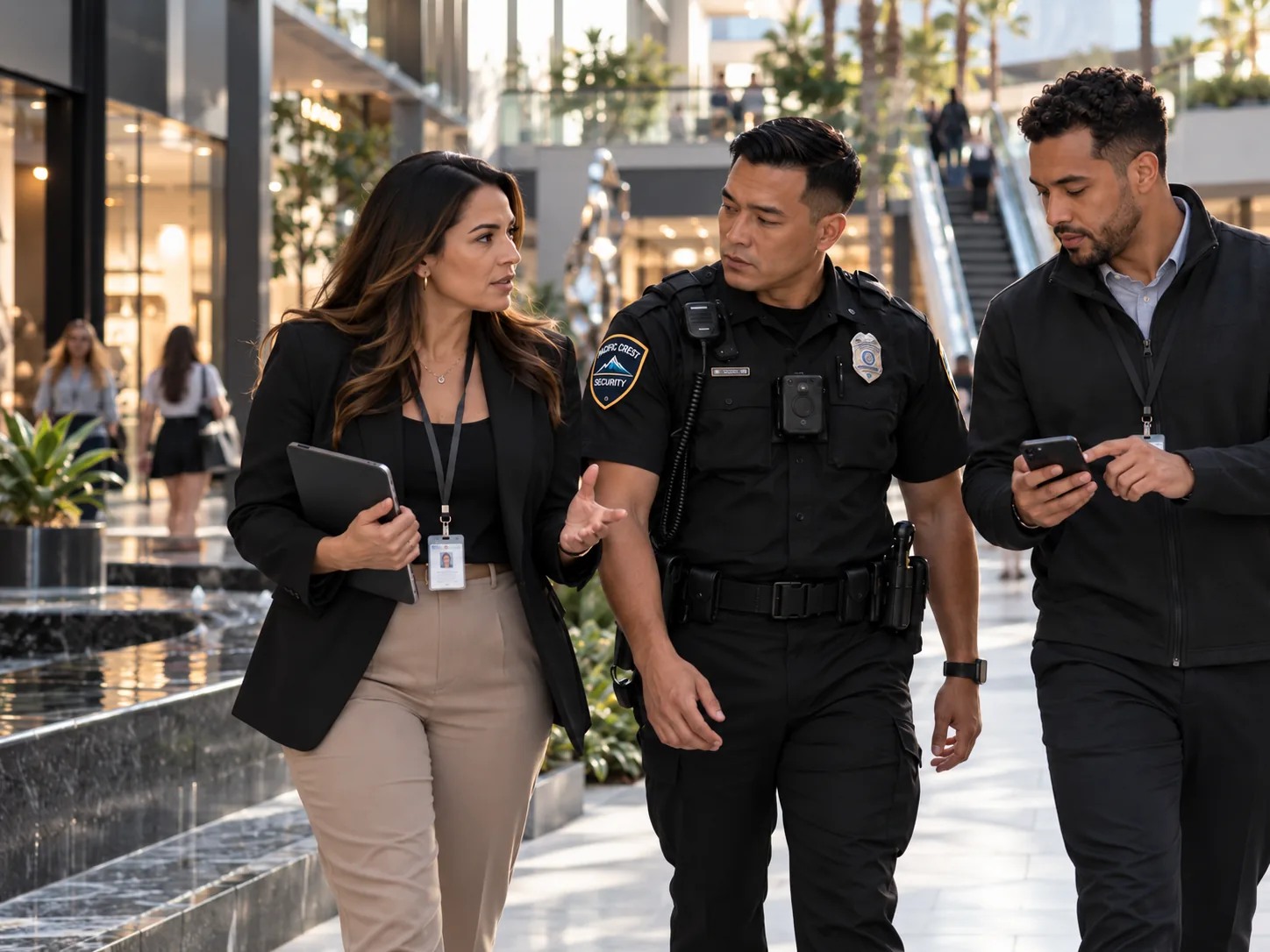
- Mobile OperationsOne adaptive field application for patrols, safety, field reports and evidence — bound to the same sites, incidents and authorization as the command center.

One platform
12 modules, one spatial model.
Every module is designed to read from the same sites, the same personnel and the same incidents. That shared model is what makes the operational picture hold together — and it is the difference between an integrated platform and a set of products that exchange messages.
Detection & Response
One incident, from raw event to accountable response.
These are ordered stages of a single incident. At no point is it re-entered into another system — which is the whole argument for a shared spatial model.
01
Detect
A camera or sensor event is ingested and reviewed rather than pushed straight to an operator as noise.
Event resolved against the site model
02
Locate
The event resolves to a zone in the site graph — a door, a floor, a room — not a bare coordinate.
Same site graph the twin was authored in
03
Assess
An operator sees the incident in place, with the cameras that cover it and the personnel nearest to it.
Same personnel presence layer
04
Dispatch
Responders are selected from the map and routed against the real site, not straight-line distance.
Same routing graph


- 05Communicate
The people assigned are addressed directly, with delivery and acknowledgement tracked per recipient.
Same incident record
- 06Review
The incident replays from its recorded timeline, so after-action review works from evidence.
Same audited event stream
Virtual Sites & Digital Twin
A site model your operators can actually navigate.
Author 360° scenes, link them into a walkable graph, and bind cameras to the positions they really cover. The twin then becomes the spatial reference every other module reads from.
- Navigable 360° scenes linked into a site graph
- Cameras bound to positions and fields of view within the model
- Drift detection when the model and the real site diverge
- The same model reused for response, training and after-action review

ChatVRTK & AI Intel
AI that is governed, grounded, and answerable.
ChatVRTK is the operator's conversational surface. Underneath it, AI Intel decides what may run: which mode, under whose policy, within what budget, and against which grounded context.
- Explicit operating modes rather than one opaque assistant
- Per-tenant policy and per-user budget enforced before execution
- Responses grounded in live operational context, not general knowledge
- Tool authorisation boundary defined by risk class
Solutions
Different operations. The same underlying model.
The platform does not change shape per sector — what changes is which modules carry the weight, and which constraints govern deployment.
Where Virtik is deployed
The platform does not change shape per sector. What changes is which modules carry the weight, and how the deployment is acquired.
- EnterpriseMulti-site corporate operations under one command picture.
- Schools & CampusesDrills, coordinated response and campus-wide situational awareness.
- HospitalityGuest-facing environments where response must stay discreet.
- RetailHigh-volume estates where loss prevention and safety overlap.
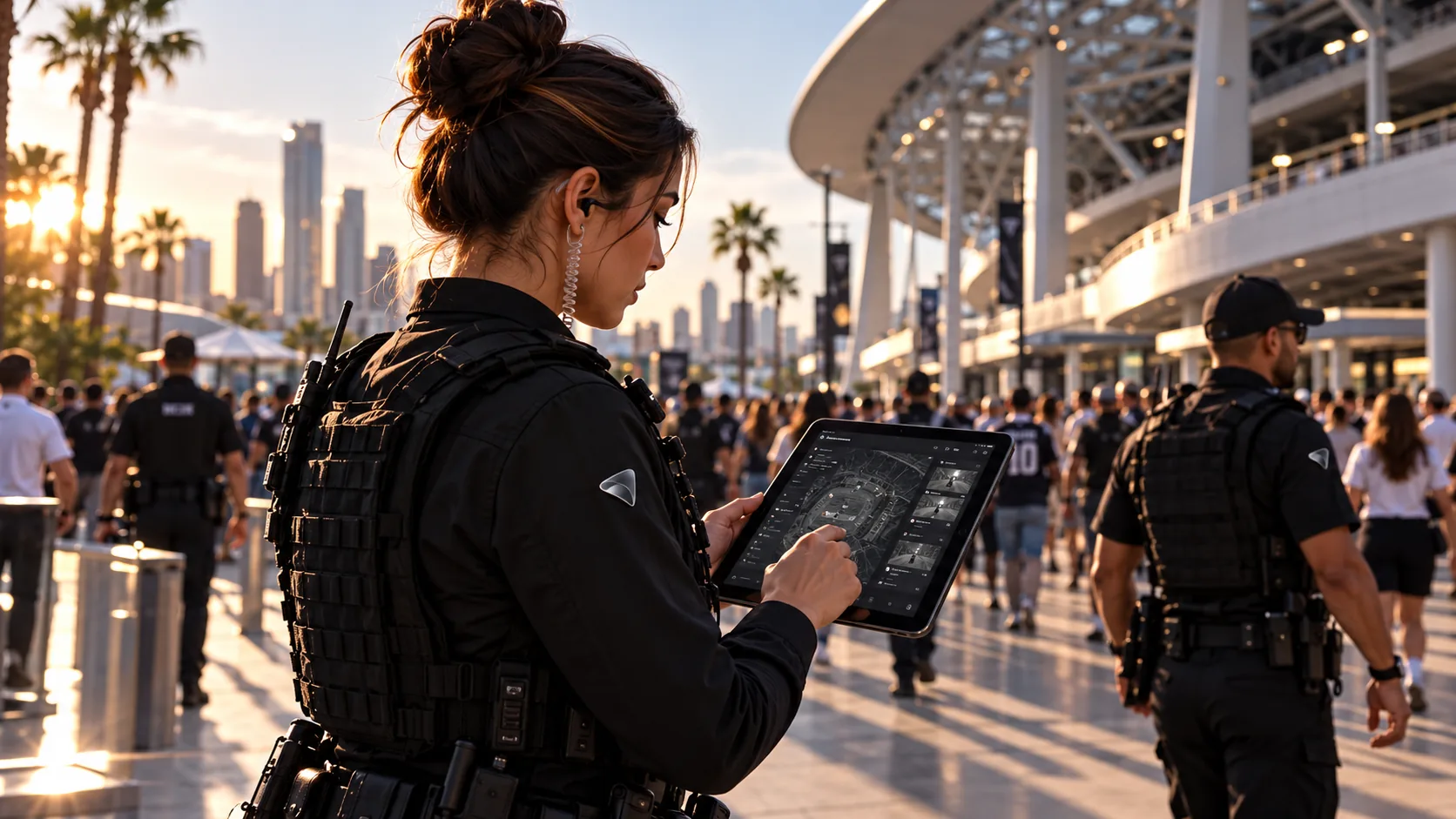
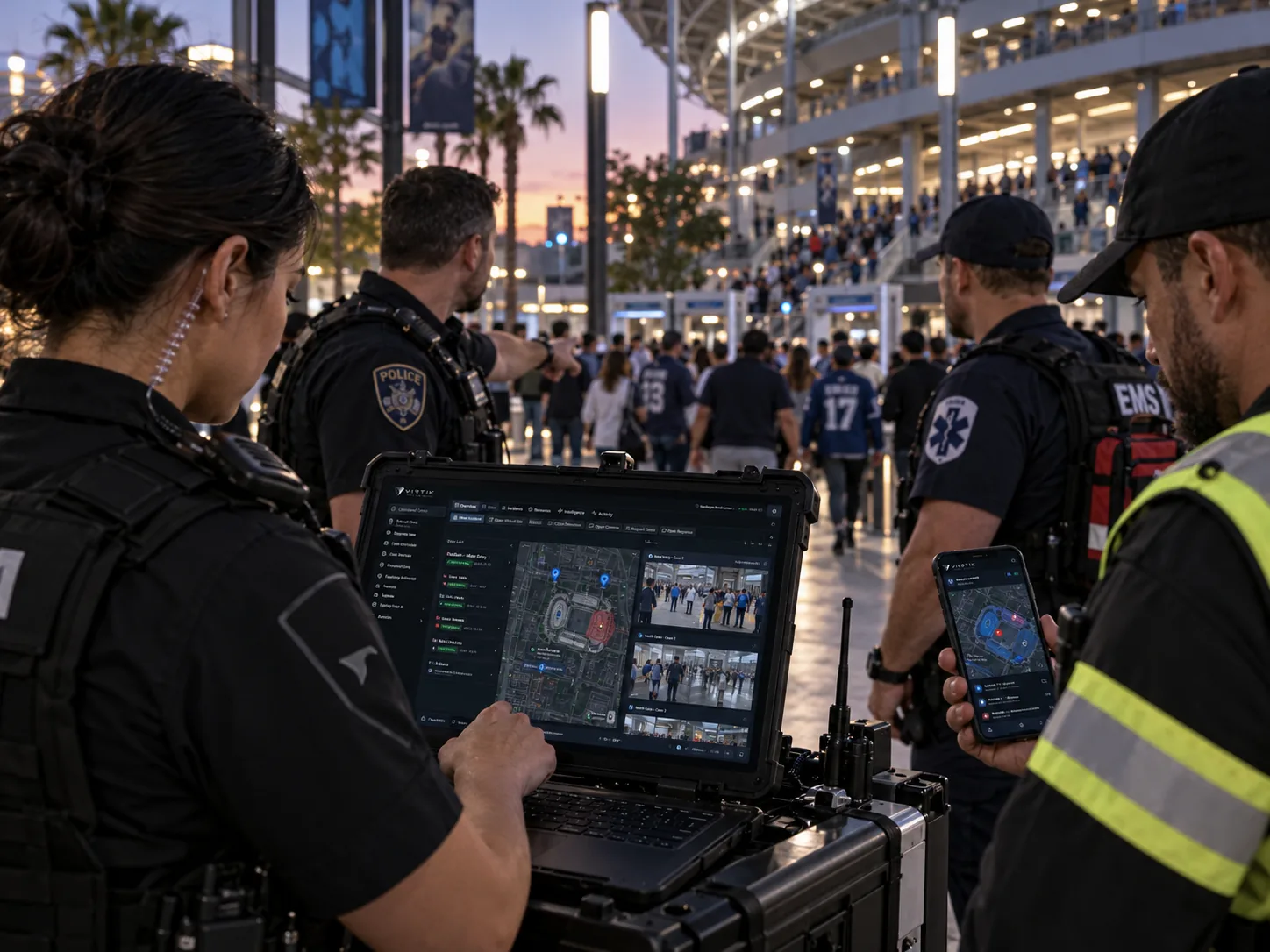
- Stadiums & EventsTemporary sites, surge staffing and time-boxed operations.
- Critical InfrastructureDistributed sites, continuous monitoring and mutual-aid coordination.
- GovernmentSovereignty, procurement and jurisdictional operating requirements.
- Public SafetyResponse-led operations coordinating across jurisdictions.
Security & trust
Built to be defensible, not just to look secure.
Security posture stated as architecture. Where a certification is not held, this site does not display one.
Tenant isolation at the data layer
Access is enforced in the database with row-level security, not only in the interface — so a client bug cannot become a data leak.
Role and entitlement dual gating
What a person may do is checked against both their operational role and their organisation's commercial entitlement, independently.
Governed AI execution
AI actions run under explicit operating modes with per-tenant policy, enforced budgets and a defined tool authorisation boundary.
Audited operational actions
Consequential actions are recorded as auditable events, so after-action review works from the record rather than from recollection.
Detailed posture and processing boundaries are set out on the security and compliance pages.
Integrations
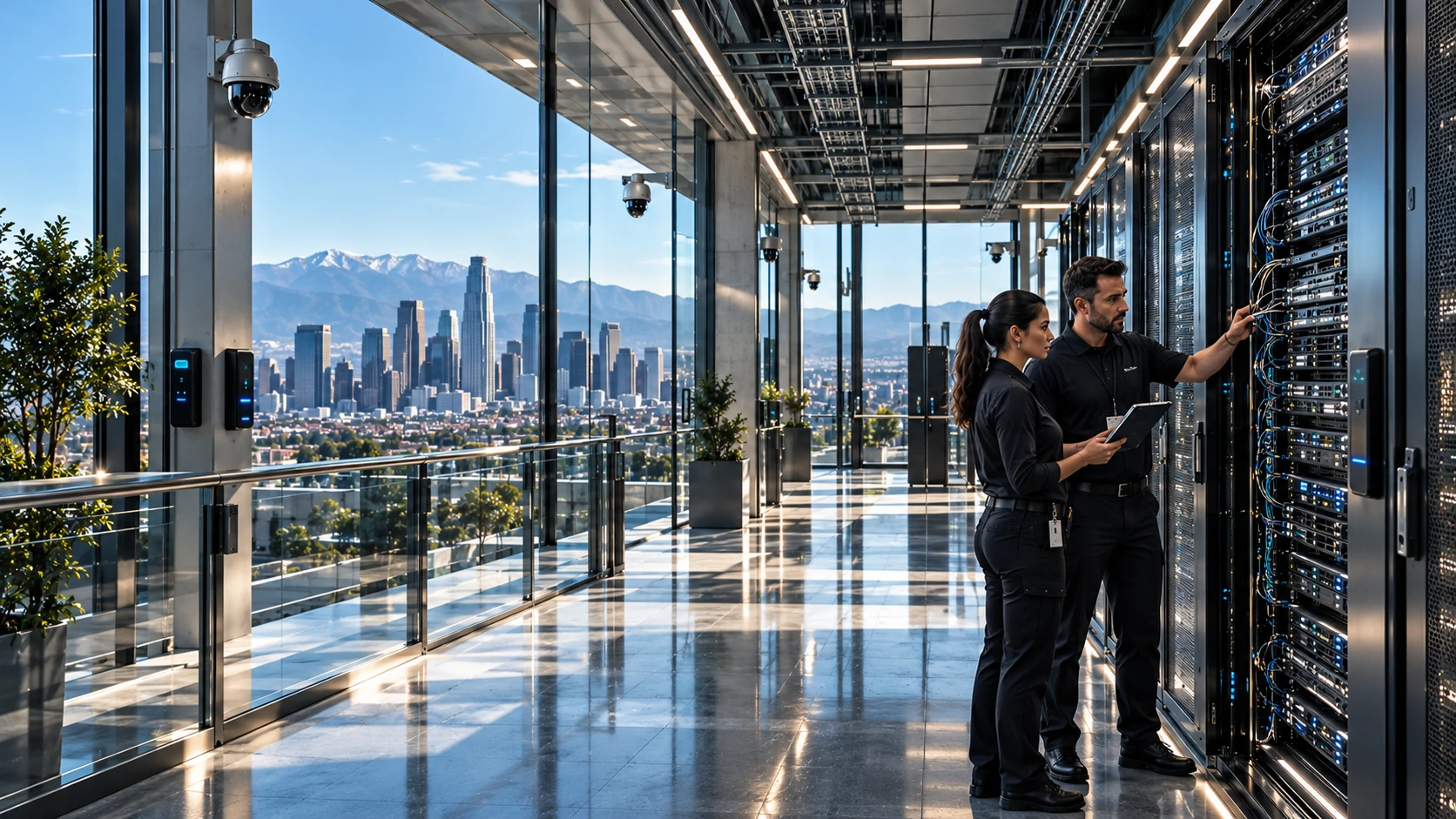
Connects at the layer that matters, under your control.
Integrations are scoped, credentialed per organisation, and governed by the same entitlement model as the rest of the platform.
Video & sensors
- ONVIF / RTSP cameras
- Access control events
- Environmental sensors
Identity & directory
- SSO providers
- Directory sync
- Role mapping
Notification transport
- SMS
- Push to mobile devices
Operational systems
- Webhooks
- Outbound event streams
- Scoped API access
Connector availability varies by plan and deployment. Specifics are confirmed during evaluation rather than asserted here.
Questions
Common questions
If something here is unresolved, evaluation is the fastest way to get a precise answer.

See it against your own sites.
A working session with your operational context — your sites, your constraints — rather than a generic product tour.